IHSG Drops 3.46%: When Financial Markets and “Vibe Coding” Start Looking Similar
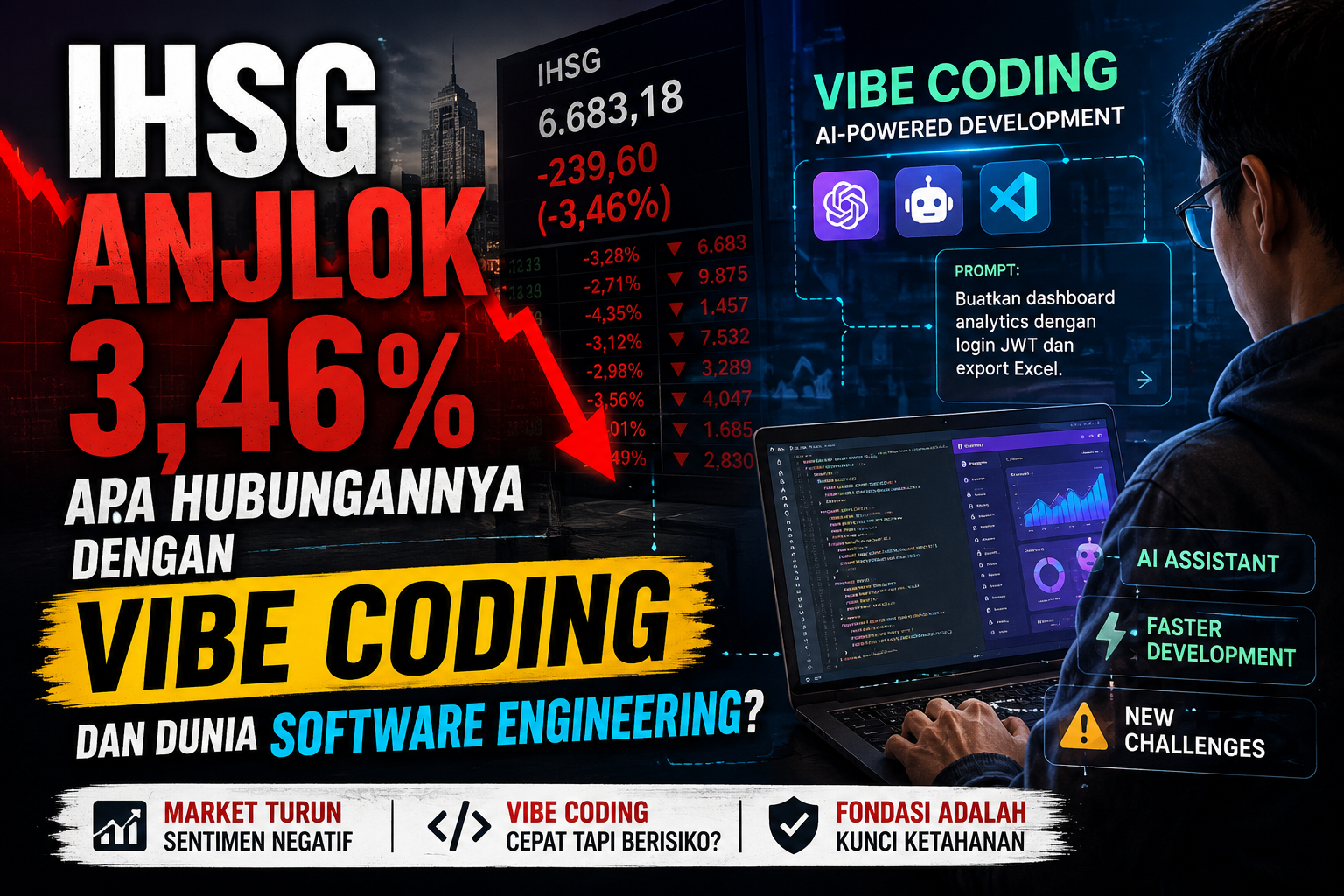
Today, Indonesia’s stock market once again made investors nervous. IHSG fell sharply by 3.46% in a single trading session. Amid global economic pressure, uncertainty, and weakening investor sentiment, another industry is quietly showing very similar patterns: modern software engineering.
That phenomenon is now widely known as vibe coding.
At first glance, stock markets and software development seem unrelated. But if we look deeper, both worlds are increasingly driven by the same forces: speed, optimism, and the pressure to move faster than ever before.
What Is Vibe Coding?
Among modern developers, vibe coding describes the process of building software rapidly with AI assistance, often without the traditional engineering workflow that used to take weeks or months.
A developer can simply type a prompt like:
“Build an analytics dashboard with JWT authentication and Excel export.”
Within seconds, AI generates most of the application structure.
Technologies from OpenAI, GitHub Copilot, and other AI coding assistants have dramatically changed the software development process. Applications that once required large engineering teams can now be prototyped in hours.
But there is an important question:
Does building faster automatically mean building better?
When Speed Starts Replacing Fundamentals
In traditional software engineering, developers spent significant time designing:
system architecture,
scalability,
security,
testing,
and long-term maintainability.
In the era of vibe coding, many of those processes are shortened in the name of speed and efficiency.
As a result, several issues are becoming increasingly common:
growing technical debt,
hidden security vulnerabilities,
unstable codebases,
and developers who no longer fully understand the systems they deploy.
This pattern looks surprisingly similar to what happens in financial markets during periods of excessive optimism.
When markets rise too quickly, valuations often become disconnected from fundamentals. The moment sentiment changes, sharp corrections follow.
The same thing is beginning to happen in modern software development.
Many products look polished on the surface, but struggle when they face real-world scale, traffic, and operational complexity.
AI Is Lowering the Barrier to Entry
One of AI’s biggest impacts is how it democratizes software creation.
Today, people without formal computer science backgrounds can build:
websites,
mobile applications,
analytics dashboards,
and even SaaS products,
simply by using AI tools.
This is undeniably powerful.
However, it also creates a flood of products built without strong engineering foundations.
The situation resembles what happens during bullish financial markets, when everyone suddenly believes investing is easy because prices keep rising.
In both technology and finance, easy growth can sometimes hide structural weaknesses.
Software Engineering Is Entering a New Era
AI will probably not replace software engineers entirely.
But it is redefining what being an engineer actually means.
In the past, engineers were valued mainly for:
writing syntax,
memorizing frameworks,
and building features manually.
Now the value is shifting toward:
system thinking,
architecture design,
validation,
risk management,
and understanding business impact.
Because in the age of vibe coding, the biggest challenge is no longer writing code.
The real challenge is ensuring AI-generated systems remain stable, secure, and maintainable over time.
Lessons from the IHSG Decline
Today’s decline in IHSG is a reminder that rapid growth without strong fundamentals is always vulnerable under pressure.
Both financial markets and software engineering are increasingly shaped by:
hype,
acceleration,
optimism,
and eventual correction.
Vibe coding is not inherently bad. In fact, it will likely become a standard part of software development in the near future.
But the engineers who thrive in this new era will not simply be those who write the fastest prompts.
They will be the ones who still understand:
architecture,
scalability,
security,
maintainability,
and the long-term consequences of the systems they build.
Because ultimately, both markets and software follow the same principle:
Sustainable growth still depends on strong foundations.